Live Kp, solar wind, and IMF data updated about every 15 minutes
Planetary Kp IndexLoading...
—/9
QuietStorm
The Kp index measures geomagnetic activity on a scale of 0-9.
Next 12 Hours
Wind Speedkm/s
—
Typical: 300–800
IMF BznT
—
Negative = Good
Densityp/cm³
—
Higher = Stronger
IMF BtnT
—
Total field strength
Definitions: Kp is global geomagnetic activity from 0–9. Solar wind speed and density describe the particle stream from the sun. Bz is the north–south IMF component; a sustained southward (negative) Bz often precedes brighter aurora. Data is from NOAA SWPC.
3-Day Forecast
Kp index predictions from NOAA
Loading forecast data...
Kp 0-3 (Quiet)
Kp 4-5 (Active)
Kp 6+ (Storm)
Recent Activity
Kp index over the past 24 hours
Kp 0-3 (Quiet)
Kp 4-5 (Active)
Kp 6+ (Storm)
Visibility by Magnetic Latitude
The Kp you need depends on magnetic latitude, not map latitude. The highlighted row is your selected city.
Denver, Washington DC, San Francisco, Rome, Madrid, Tokyo
Magnetic latitude is measured from the geomagnetic pole over northwest Greenland, so North America sees aurora at lower Kp than Europe or Asia at the same map latitude. Thresholds follow NOAA SWPC's overhead-aurora table; a strong display is often visible low on the horizon one Kp step earlier.
Viewing Tips
Look north — Aurora appears on the northern horizon for most viewers in the Northern Hemisphere
Higher Kp = further south — Strong storms push aurora visibility to lower latitudes
Elevation helps — Mountains or hills with clear northern views are ideal
Allow 30+ minutes — Your eyes need time to adapt to darkness
Check hourly — Activity can spike rapidly with substorms
Solar Cycle Status
Aurora frequency follows the 11-year solar cycle
Solar Cycle 25
Current PhaseEarly declining phase
Solar Cycle 25 reached its smoothed maximum in October 2024. Activity is still elevated in 2026, so strong storms remain more likely than they will be later this decade.
Minimum 2019Maximum Oct 2024Minimum 2030–31
What this means
During and after solar maximum, the sun produces more flares and coronal mass ejections (CMEs). Those can still trigger bright aurora on the declining phase.
How to take advantage
Watch Kp and Bz on this page rather than waiting for the next maximum around 2035. Mid-latitude Kp 6–7 events remain possible over the next few years.
Tip: Go faster! Long exposures will blur the beautiful structure. Capture the movement.
Storm / CoronaKp 8–9
Explosive activity! Corona overhead, rays shooting in all directions. Rare and spectacular — shoot fast!
Aperturef/1.4 – f/2
Shutter1 – 4 sec
ISO3200 – 6400
Tip: Point straight up for corona shots! Use your widest lens. This is a once-in-a-lifetime opportunity.
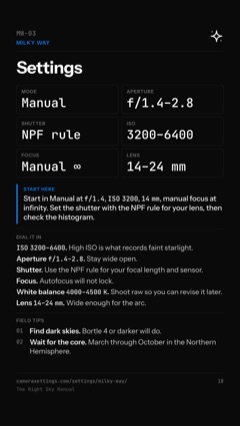
Universal settings: Always shoot RAW, use manual focus at infinity (fine-tune on a bright star), turn off image stabilization on tripod, and use a 2-second timer or remote trigger. Full exposure recipes: Aurora camera settings.
Related Settings and Guides
Live data here. Exposure recipes and gear on these pages.
Aurora Tracker FAQ
Kp index, visibility, camera settings, and when to chase
Can I see the northern lights tonight?
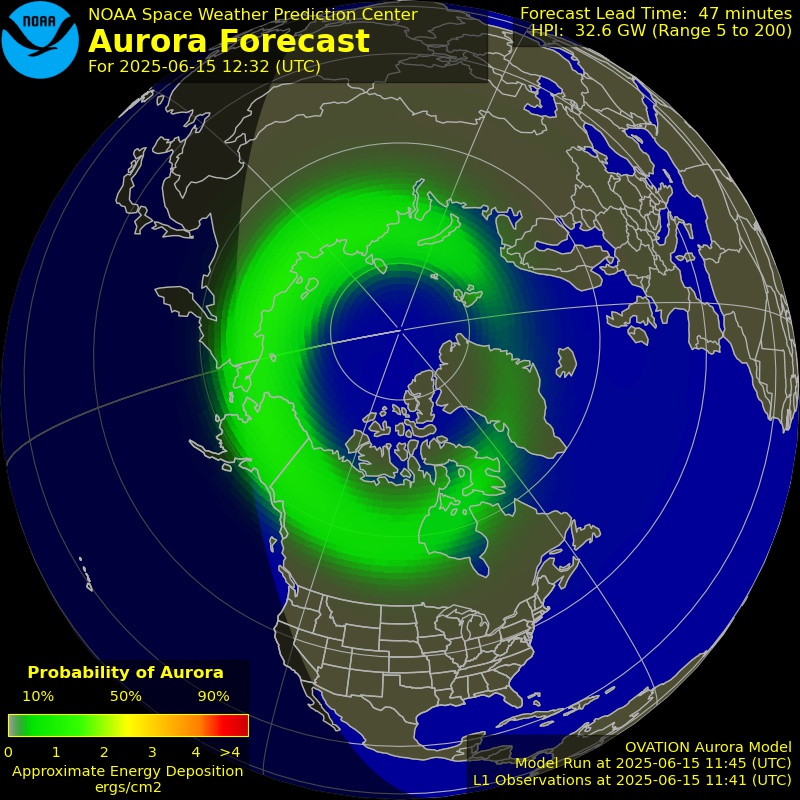
It depends on your magnetic latitude and the current Kp index. Enter a city or use your location on this page. If tonight's Kp meets or exceeds the level in the visibility table for your location, and the sky is fully dark (sun about 12° or more below the horizon), aurora is possible. Cloud cover and light pollution still matter.
What is the Kp index?
The Kp index measures global geomagnetic activity on a scale from 0 to 9. Higher Kp means a stronger storm and aurora visibility farther from the poles. NOAA treats Kp 0–4 as quiet through active, Kp 5 as a minor (G1) storm, and Kp 8–9 as severe to extreme (G4–G5).
What Kp do I need to see the northern lights?
It depends on magnetic latitude, not map latitude. Fairbanks, Yellowknife, Tromsø, and Reykjavik see aurora at Kp 0–2. Edmonton, Oslo, and Scotland need about Kp 4–5. Vancouver, Montreal, Seattle, and London need Kp 6–7. Chicago, Boston, Paris, and Berlin need about Kp 8, New York Kp 9, and cities farther south only see aurora in extreme storms. Use the visibility table on this page for more examples.
What camera settings should I use for aurora photography?
Start with a fast wide lens at f/1.4–f/2.8, ISO 1600–6400, and 5–15 second exposures on a tripod. Bright, fast aurora needs shorter shutters (1–8 sec) so curtains stay sharp. Shoot RAW, focus manually on a bright star, and see Settings by Aurora Intensity on this page for Kp-based recipes.
Which direction do I look for the aurora?
In the Northern Hemisphere, look north toward the horizon unless activity is strong enough for corona overhead. Dark skies away from city light matter more than exact compass bearing. Clear northern views from a hill or shoreline help.
When is the best time to photograph the northern lights?
A fully dark sky is required, so winter nights at high latitudes are best. Peak hours are often 10pm–2am local time. Activity follows the 11-year solar cycle. Solar Cycle 25 peaked in late 2024; conditions stay elevated through 2026, which keeps the odds of strong storms higher than in solar minimum.
Why does a southward Bz matter for aurora?
Bz is the north–south component of the interplanetary magnetic field. A sustained southward Bz (negative) couples solar wind energy into Earth’s magnetosphere and often precedes brighter aurora. High wind speed plus southward Bz is a strong chase signal.