Settings Breakdown
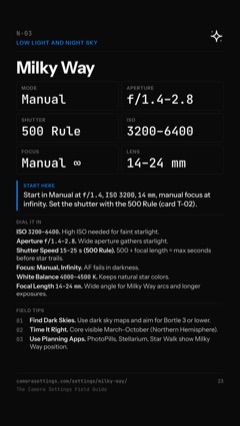
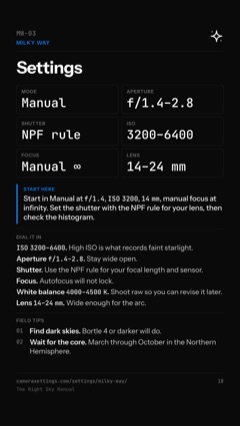
Higher ISO captures brighter aurora, especially fast-moving displays. Faint aurora needs higher ISO; bright active displays can use lower for cleaner results.
Wide apertures gather maximum light for shorter exposures. Fast lenses (f/1.4-2.0) are ideal for capturing aurora movement and detail.
Balance exposure with aurora movement. Fast-moving aurora needs 2-5s to show structure; slow aurora can use 10-15s for brighter results.
Pre-focus on stars or distant lights before the aurora appears. Use Live View at 10x magnification to nail critical focus on infinity.
Shoot RAW for maximum flexibility. A good starting point is 3500-4000K to keep greens natural without making them yellow. Adjust to taste in post.
Use intervalometer for consistent timing between shots. Enables time-lapse compilation later. Continuous mode works during peak activity.
Essential Gear for Aurora / Northern Lights
Fast wide-angle lens
Astro is an aperture game: going from f/4 to f/1.8 more than doubles the starlight you capture in the same 20 seconds.
See mount picksSturdy tripod
Milky Way and aurora exposures run 15–25 seconds.
View on AmazonIntervalometer
Star trails and stacked Milky Way frames need dozens of identical exposures.
View on AmazonPro Tips
Check Tonight's Forecast
Use the Aurora Tracker for live Kp against your city, then a clear-sky chart for clouds. Dark, moonless skies help faint displays.
Escape Light Pollution
Get away from city lights. Even faint light pollution competes with aurora. Dark skies are essential for capturing subtle aurora colors.
Include Foreground
Aurora alone can be boring. Include interesting foreground — mountains, trees, reflections in water, interesting terrain. Adds scale and context.
Dress for Extreme Cold
Aurora hunting means hours outside in freezing temps. Layer up, bring hand warmers. Cold fingers can't operate cameras effectively.
Protect Batteries
Batteries drain fast in cold. Keep spares warm inside your jacket. Rotate batteries — cold ones warm up and recover capacity.
Light Paint Foreground
Use a headlamp or flashlight to briefly illuminate foreground during exposure. Adds dimension and reveals detail in dark landscapes.