Sunrise
- First light
- Golden hour ends
- Direction
- —
Sun Calculator for Photographers
Exact sunrise and sunset times for your location on any date, with first and last light and sun direction.
Times are shown in the local time of the selected location.
—
How these times work: Sunrise and sunset are when the top edge of the sun meets a flat, sea-level horizon. Mountains, buildings, or a low cloud bank on the horizon hide the sun a few minutes after sunrise and before sunset, so plan with a margin.
Every twilight phase, with the direction the sun is in at that moment. The next event today is marked.
| Event | Time | Sun angle | Direction | For photographers |
|---|---|---|---|---|
| Morning | ||||
| Astronomical dawn | −18° | — | True darkness ends. Last chance for Milky Way and deep-sky frames. | |
| Nautical dawn | −12° | — | The horizon line appears. Deep blue sky behind dark landforms. | |
| First light civil dawn | −6° | — | Blue hour begins. Enough light to work without a headlamp. | |
| Blue hour ends | −4° | — | Pre-sunrise glow builds. Clouds near the horizon start to color. | |
| Sunrise | 0° | — | Sun clears the horizon and golden hour begins. Bracket for the bright sun. | |
| Golden hour ends | +6° | — | Light turns cooler and harder as shadows shorten. | |
| Midday | ||||
| Solar noon | — | — | Sun at its highest. Hardest light of the day; look for shade or go abstract. | |
| Evening | ||||
| Golden hour starts | +6° | — | Warm, low side light. Be set up and composed by now. | |
| Sunset | 0° | — | Sun drops below the horizon. Don’t pack up yet. | |
| Blue hour starts | −4° | — | Afterglow fades into even blue light. City lights balance with the sky. | |
| Last light civil dusk | −6° | — | Blue hour ends. Switch to long exposures on a tripod. | |
| Nautical dusk | −12° | — | Horizon fades out. Bright stars and planets show. | |
| Astronomical dusk | −18° | — | Full darkness. The astrophotography window opens. | |
Missing times? Far from the equator the sun may not dip far enough below the horizon for some twilight phases, especially near the June solstice. Those rows show a dash. For star photography after dark, see the Night Sky Planner.
Compass bearings for the selected date, and how far they swing through the year at this location.
The sun rises due east and sets due west only around the March and September equinoxes. In summer it rises and sets toward the pole you are closer to; in winter it swings the other way. That swing decides which season the sun will set behind a landmark, down a street, or along a coastline.
Bearings are true north. A phone compass app set to true north, or a map app, will line them up. For moonrise and moonset bearings, use Sun & Moon Direction.
Every day of the month for the selected location. Choose a date to plan it.
| Date | First light | Sunrise | Sunset | Last light | Day length | Change |
|---|
A timed plan for the selected date. The best color rarely happens at the moment of sunrise or sunset.
Arrive and set up. Compose in the dark with a headlamp. Scout the spot the day before if you can.
First light. Blue hour begins. Long exposures of water and skyline on a tripod.
Peak color. Clouds usually light up most strongly in the 20 minutes before the sun appears.
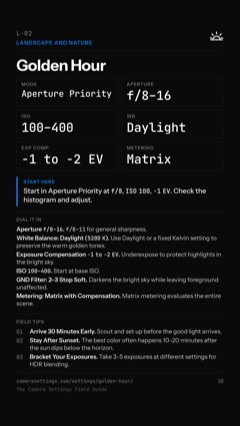
Sunrise. Bracket ±2 EV or use a graduated ND filter. Stop down to f/16 for a sunstar.
Golden hour ends. Side light for landscapes and portraits until now.
Arrive and set up. Find foreground interest and level the tripod before the light moves.
Golden hour. Warm, low light. Portraits with the sun behind the subject for rim light.
Sunset. Meter for the sky beside the sun to keep color. Foreground goes to silhouette.
Afterglow. Stay. High clouds often turn red and pink 10 to 20 minutes after sunset.
Last light. Blue hour ends. Cityscapes and light trails need 2 to 30 second exposures.
Fits a big sky and a foreground in one frame at 16–35mm.
See mount picksDarkens a bright sky so the foreground and the sunset fit in one exposure. Bracketing is the free alternative.
View on AmazonFirst light, afterglow, and blue hour all need shutter speeds slower than you can hand-hold.
View on AmazonTiming, direction, and when to shoot
Sunset today for your location is shown at the top of this page in local time. Allow the page to use your location or pick the nearest city. Sunset is the moment the top edge of the sun drops below a flat, sea-level horizon, so hills or buildings to the west will hide the sun a few minutes earlier.
First light (civil dawn) is when the sun is 6° below the horizon and there is enough light to work outdoors without a lamp. At mid-latitudes it comes 25 to 35 minutes before sunrise, and it is when blue hour begins. Last light (civil dusk) is the evening equivalent, 25 to 35 minutes after sunset.
This calculator uses the NOAA solar position algorithm. Sunrise and sunset are the moments the sun’s upper edge meets the horizon, which happens when its center is 0.833° below it: about 0.27° for the sun’s radius plus 0.57° for atmospheric refraction. Times are accurate to about a minute for a sea-level horizon. Elevation, terrain, and unusual refraction can shift what you see by a few minutes.
Solar noon drifts by several minutes through the year, an effect called the equation of time. At northern mid-latitudes the earliest sunset falls in early December and the latest sunrise in early January, even though the shortest day is the December solstice. The monthly calendar on this page shows the drift day by day.
Start at golden hour, roughly an hour before sunset, when the light is warm and low. Stay 20 to 30 minutes after the sun goes down: clouds often light up most strongly after sunset, and blue hour follows. For sunrise, reverse it and arrive before first light, because the best color in the clouds usually comes before the sun clears the horizon.
The sun’s disk takes about 2 to 3 minutes to sink below the horizon at low and mid-latitudes, and longer near the poles, where it sets at a shallow angle. The full show of golden hour, sunset, afterglow, and blue hour usually runs about an hour and a half.
No. The sun rises due east and sets due west only around the March and September equinoxes. At 40° north it rises as far north as about 58° (northeast) at the June solstice and as far south as about 122° (southeast) in December, and sunset mirrors that in the west. The Sun Direction section on this page shows the bearings and the yearly range for your location.