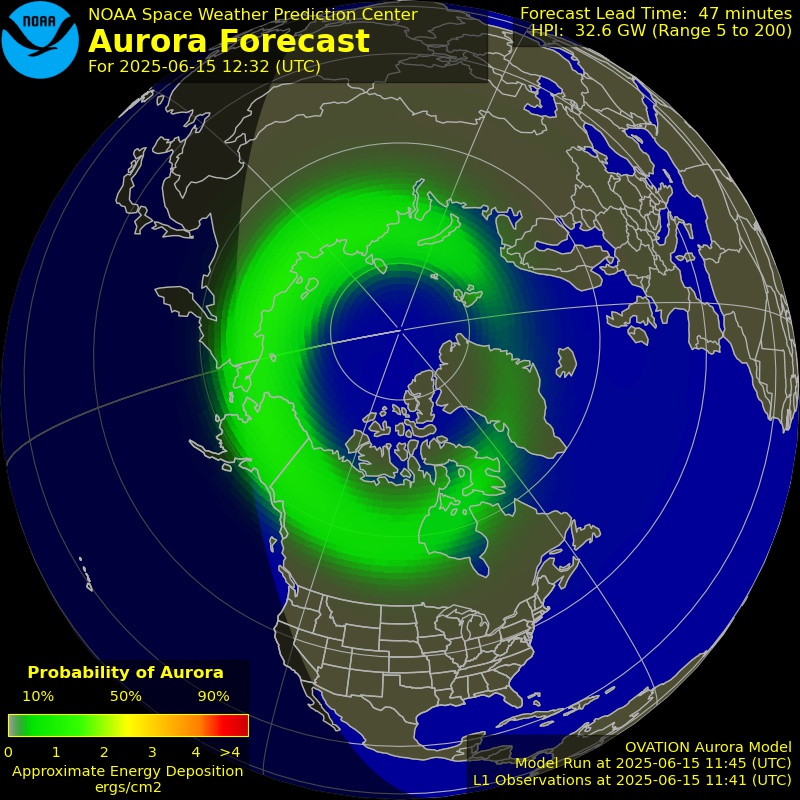
The Kp index measures geomagnetic activity on a scale of 0-9.
Current Conditions
Live data updated every 15 minutes
3-Day Forecast
Kp index predictions from NOAA
Loading forecast data...
Recent Activity
Kp index over the past 24 hours
Visibility by Latitude
What Kp level do you need to see the aurora from your location?
| Kp Index | Visible From | Example Locations |
|---|---|---|
| Kp 0–1 | 66°N+ | Fairbanks, Tromsø, Reykjavik |
| Kp 2–3 | 62–66°N | Anchorage, Northern Iceland, Rovaniemi |
| Kp 4 | 58–62°N | Juneau, Stockholm, Helsinki, Oslo |
| Kp 5 | 54–58°N | Edmonton, Glasgow, Copenhagen, Moscow |
| Kp 6 | 50–54°N | Vancouver, Seattle, London, Amsterdam, Berlin |
| Kp 7 | 46–50°N | Portland, Montreal, Paris, Munich, Prague |
| Kp 8 | 42–46°N | Boston, Chicago, Rome, Barcelona, Denver |
| Kp 9 | 38–42°N | San Francisco, Washington DC, Madrid, Athens |
Viewing Tips
- Look north — Aurora appears on the northern horizon for most viewers in the Northern Hemisphere
- Higher Kp = further south — Strong storms push aurora visibility to lower latitudes
- Elevation helps — Mountains or hills with clear northern views are ideal
- Allow 30+ minutes — Your eyes need time to adapt to darkness
- Check hourly — Activity can spike rapidly with substorms
Solar Cycle Status
Aurora frequency follows the 11-year solar cycle
We're at the peak of Solar Cycle 25 (2024–2026). This means more frequent and intense aurora displays — the best viewing conditions in over a decade!
2019 Maximum
2024–26 Minimum
2030–31
During solar maximum, the sun produces more sunspots, solar flares, and coronal mass ejections (CMEs) — all of which can trigger spectacular aurora displays.
Plan aurora trips in the next 1–2 years for the best odds. Even mid-latitude locations (Kp 6–7 events) are seeing more frequent activity during this peak period.
Settings by Aurora Intensity
Adapt your camera settings based on how active the aurora is
Barely visible to naked eye, often appears as a gray-green glow on the horizon. Camera will capture more than you can see.
Tip: Use longer exposures to pull out color. Stars will trail slightly — that's okay.
Clearly visible green bands or curtains. May show movement. This is the "sweet spot" for photography.
Tip: Balance exposure time with movement — shorter exposures preserve structure in moving curtains.
Vivid, fast-moving curtains and bands. Multiple colors visible (green, purple, red). Rapidly changing shapes.
Tip: Go faster! Long exposures will blur the beautiful structure. Capture the movement.
Explosive activity! Corona overhead, rays shooting in all directions. Rare and spectacular — shoot fast!
Tip: Point straight up for corona shots! Use your widest lens. This is a once-in-a-lifetime opportunity.
Data provided by NOAA Space Weather Prediction Center